std::round, std::roundf, std::roundl, std::lround, std::lroundf, std::lroundl, std::llround, std::llroundf
| Definiert in der Header-Datei <cmath> |
||
| Runden auf Gleitkommatypen |
||
| (1) | ||
float round ( float num ); double round ( double num ); |
(seit C++11) (bis C++23) |
|
| constexpr /* gleitkommazahl-Typ */ round ( /* floating-point-type */ num ); |
(seit C++23) | |
| float roundf( float num ); |
(2) | (seit C++11) (constexpr seit C++23) |
| long double roundl( long double num ); |
(3) | (seit C++11) (constexpr seit C++23) |
| Runden auf long |
||
| (4) | ||
long lround ( float num ); long lround ( double num ); |
(seit C++11) (bis C++23) |
|
| constexpr long lround( /* floating-point-type */ num ); |
(seit C++23) | |
| long lroundf( float num ); |
(5) | (seit C++11) (constexpr seit C++23) |
| long lroundl( long double num ); |
(6) | (seit C++11) (constexpr seit C++23) |
| Runden auf long long |
||
| (7) | ||
long long llround ( float num ); long long llround ( double num ); |
(seit C++11) (bis C++23) |
|
| constexpr long long llround( /* floating-point-type */ num ); |
(seit C++23) | |
| long long llroundf( float num ); |
(8) | (seit C++11) (constexpr seit C++23) |
| long long llroundl( long double num ); |
(9) | (seit C++11) (constexpr seit C++23) |
| Definiert in der Header-Datei <cmath> |
||
| template< class Integer > double round( Integer num ); |
(A) | (seit C++11) (constexpr seit C++23) |
| template< class Integer > long lround( Integer num ); |
(B) | (seit C++11) (constexpr seit C++23) |
| template< class Integer > long long llround( Integer num ); |
(C) | (seit C++11) (constexpr seit C++23) |
std::round für alle nicht-const-und-nicht-volatile Gleitkommatypen als Parameter-Typ für num bereit.(seit C++23)std::lround und std::llround für alle nicht-const-und-nicht-volatile Gleitkommatypen als Parameter-Typ für num bereit.(seit C++23)Inhalt |
[edit] Parameter
| num | - | Gleitkomma- oder Ganzzahlwert |
[edit] Rückgabewert
Wenn keine Fehler auftreten, wird der nächstgelegene ganzzahlige Wert von num zurückgegeben, wobei halbzahlige Fälle von Null weg gerundet werden.
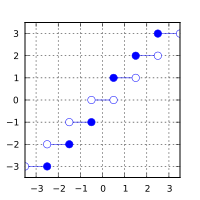
Wenn ein Domänenfehler auftritt, wird ein implementierungsdefinierter Wert zurückgegeben.
[edit] Fehlerbehandlung
Fehler werden wie in math_errhandling beschrieben gemeldet.
Wenn das Ergebnis von std::lround oder std::llround außerhalb des durch den Rückgabetyp darstellbaren Bereichs liegt, kann ein Domänenfehler oder ein Bereichsfehler auftreten.
Wenn die Implementierung IEEE-Gleitkomma-Arithmetik (IEC 60559) unterstützt,
- Für die Funktion
std::round- Der aktuelle Rundungsmodus hat keinen Einfluss.
- Wenn num ±∞ ist, wird es unverändert zurückgegeben.
- Wenn num ±0 ist, wird es unverändert zurückgegeben.
- Wenn num NaN ist, wird NaN zurückgegeben.
- Für die Funktionen
std::lroundundstd::llround- FE_INEXACT wird nie ausgelöst.
- Der aktuelle Rundungsmodus hat keinen Einfluss.
- Wenn num ±∞ ist, wird FE_INVALID ausgelöst und ein implementierungsdefinierter Wert zurückgegeben.
- Wenn das Ergebnis der Rundung außerhalb des Bereichs des Rückgabetyps liegt, wird FE_INVALID ausgelöst und ein implementierungsdefinierter Wert zurückgegeben.
- Wenn num NaN ist, wird FE_INVALID ausgelöst und ein implementierungsdefinierter Wert zurückgegeben.
[edit] Hinweise
FE_INEXACT kann ausgelöst werden (ist aber nicht zwingend erforderlich) von std::round, wenn ein endlicher Wert gerundet wird, der keine Ganzzahl ist.
Die größten darstellbaren Gleitkommawerte sind in allen Standard-Gleitkommaformaten exakte ganze Zahlen, daher kommt es bei std::round nie zu einem Überlauf; das Ergebnis kann jedoch bei Speicherung in einer Ganzzahlvariable jeden Ganzzahltyp (einschließlich std::intmax_t) überlaufen.
POSIX gibt an, dass alle Fälle, in denen std::lround oder std::llround FE_INEXACT auslösen, Domänenfehler sind.
Die double-Version von std::round verhält sich so, als wäre sie wie folgt implementiert
#include <cfenv>
#include <cmath>

#pragma STDC FENV_ACCESS ON

double round(double x)
{
    const int save_round = std::fegetround();
    std::fesetround(FE_TOWARDZERO);
    const double result = std::rint(std::copysign(0.5 + std::fabs(x), x));
    std::fesetround(save_round);
    return result;
}
Die zusätzlichen Überladungen müssen nicht exakt wie (A-C) angegeben werden. Sie müssen nur ausreichen, um sicherzustellen, dass für ihr Argument num vom Ganzzahltyp
- std::round(num) denselben Effekt hat wie std::round(static_cast<double>(num)).
- std::lround(num) hat denselben Effekt wie std::lround(static_cast<double>(num)).
- std::llround(num) hat denselben Effekt wie std::llround(static_cast<double>(num)).
[edit] Beispiel
#include <cassert>
#include <cfenv>
#include <cfloat>
#include <climits>
#include <cmath>
#include <iostream>

// #pragma STDC FENV_ACCESS ON

double custom_round(double x)
{
    const int save_round = std::fegetround();
    std::fesetround(FE_TOWARDZERO);
    const double result = std::rint(std::copysign(0.5 + std::fabs(x), x));
    std::fesetround(save_round);
    return result;
}

void test_custom_round()
{
    for (const double x :
        {
            0.0, 0.3,
            0.5 - DBL_EPSILON / 2,
            0.5,
            0.5 + DBL_EPSILON / 2,
            0.7, 1.0, 2.3, 2.5, 2.7, 3.0,
            static_cast<double>(INFINITY)
        })
        assert(round(+x) == custom_round(+x) && round(-x) == custom_round(-x));
}

int main()
{
    test_custom_round();

    std::cout << std::showpos;

    // round
    std::cout << "round(+2.3) = " << std::round(2.3)
              << "  round(+2.5) = " << std::round(2.5)
              << "  round(+2.7) = " << std::round(2.7) << '\n'
              << "round(-2.3) = " << std::round(-2.3)
              << "  round(-2.5) = " << std::round(-2.5)
              << "  round(-2.7) = " << std::round(-2.7) << '\n';

    std::cout << "round(-0.0) = " << std::round(-0.0)  << '\n'
              << "round(-Inf) = " << std::round(-INFINITY) << '\n';

    // lround
    std::cout << "lround(+2.3) = " << std::lround(2.3)
              << "  lround(+2.5) = " << std::lround(2.5)
              << "  lround(+2.7) = " << std::lround(2.7) << '\n'
              << "lround(-2.3) = " << std::lround(-2.3)
              << "  lround(-2.5) = " << std::lround(-2.5)
              << "  lround(-2.7) = " << std::lround(-2.7) << '\n';

    std::cout << "lround(-0.0) = " << std::lround(-0.0)  << '\n'
              << "lround(-Inf) = " << std::lround(-INFINITY) << '\n';

    // error handling
    std::feclearexcept(FE_ALL_EXCEPT);

    std::cout << "std::lround(LONG_MAX+1.5) = "
              << std::lround(LONG_MAX + 1.5) << '\n';
    if (std::fetestexcept(FE_INVALID))
        std::cout << "    FE_INVALID was raised\n";
}
Mögliche Ausgabe
round(+2.3) = +2  round(+2.5) = +3  round(+2.7) = +3
round(-2.3) = -2  round(-2.5) = -3  round(-2.7) = -3
round(-0.0) = -0
round(-Inf) = -inf
lround(+2.3) = +2  lround(+2.5) = +3  lround(+2.7) = +3
lround(-2.3) = -2  lround(-2.5) = -3  lround(-2.7) = -3
lround(-0.0) = +0
lround(-Inf) = -9223372036854775808
std::lround(LONG_MAX+1.5) = -9223372036854775808
FE_INVALID was raised[edit] Siehe auch
| (C++11)(C++11) |
nächste ganze Zahl, die nicht größer ist als der gegebene Wert (Funktion) |
| (C++11)(C++11) |
nächste ganze Zahl, die nicht kleiner ist als der gegebene Wert (Funktion) |
| (C++11)(C++11)(C++11) |
nächste ganze Zahl, die nicht größer im Betrag ist als der gegebene Wert (Funktion) |
| C-Dokumentation für round
| |


