std::unordered_map<Key,T,Hash,KeyEqual,Allocator>::begin, std::unordered_map<Key,T,Hash,KeyEqual,Allocator>::cbegin
Von cppreference.com
< cpp | container | unordered map
| iterator begin() noexcept; |
(1) | (seit C++11) |
| const_iterator begin() const noexcept; |
(2) | (seit C++11) |
| const_iterator cbegin() const noexcept; |
(3) | (seit C++11) |
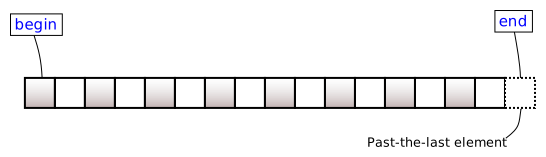
Gibt einen Iterator zum ersten Element des unordered_map zurück.
Wenn das unordered_map leer ist, ist der zurückgegebene Iterator gleich end().
Inhalt |
[bearbeiten] Rückgabewert
Iterator zum ersten Element.
[bearbeiten] Komplexität
Konstant.
[bearbeiten] Beispiel
Führen Sie diesen Code aus
#include <cmath>
#include <iostream>
#include <unordered_map>

struct Node { double x, y; };

int main()
{
    Node nodes[3] = {{1, 0}, {2, 0}, {3, 0}};

    // mag is a map mapping the address of a Node to its magnitude in the plane
    std::unordered_map<Node*, double> mag =
    {
        { nodes + 0, 1 },
        { nodes + 1, 2 },
        { nodes + 2, 3 }
    };

    // Change each y-coordinate from 0 to the magnitude
    for (auto iter = mag.begin(); iter != mag.end(); ++iter)
    {
        auto cur = iter->first; // pointer to Node
        cur->y = mag[cur]; // could also have used cur->y = iter->second;
    }

    // Update and print the magnitude of each node
    for (auto iter = mag.begin(); iter != mag.end(); ++iter)
    {
        auto cur = iter->first;
        mag[cur] = std::hypot(cur->x, cur->y);
        std::cout << "The magnitude of (" << cur->x << ", " << cur->y << ") is ";
        std::cout << iter->second << '\n';
    }

    // Repeat the above with the range-based for loop
    for (auto i : mag)
    {
        auto cur = i.first;
        cur->y = i.second;
        mag[cur] = std::hypot(cur->x, cur->y);
        std::cout << "The magnitude of (" << cur->x << ", " << cur->y << ") is ";
        std::cout << mag[cur] << '\n';
        // Note that in contrast to std::cout << iter->second << '\n'; above,
        // std::cout << i.second << '\n'; will NOT print the updated magnitude
    }
}
Mögliche Ausgabe
The magnitude of (3, 3) is 4.24264
The magnitude of (1, 1) is 1.41421
The magnitude of (2, 2) is 2.82843
The magnitude of (3, 4.24264) is 5.19615
The magnitude of (1, 1.41421) is 1.73205
The magnitude of (2, 2.82843) is 3.4641
[bearbeiten] Siehe auch
| gibt einen Iterator zum Ende zurück (public member function) | |
| (C++11)(C++14) |
gibt einen Iterator zum Anfang eines Containers oder Arrays zurück (Funktionsvorlage) |


